
AI Writing Prompts for Thought Leaders Who Want to Sound Original Every Time
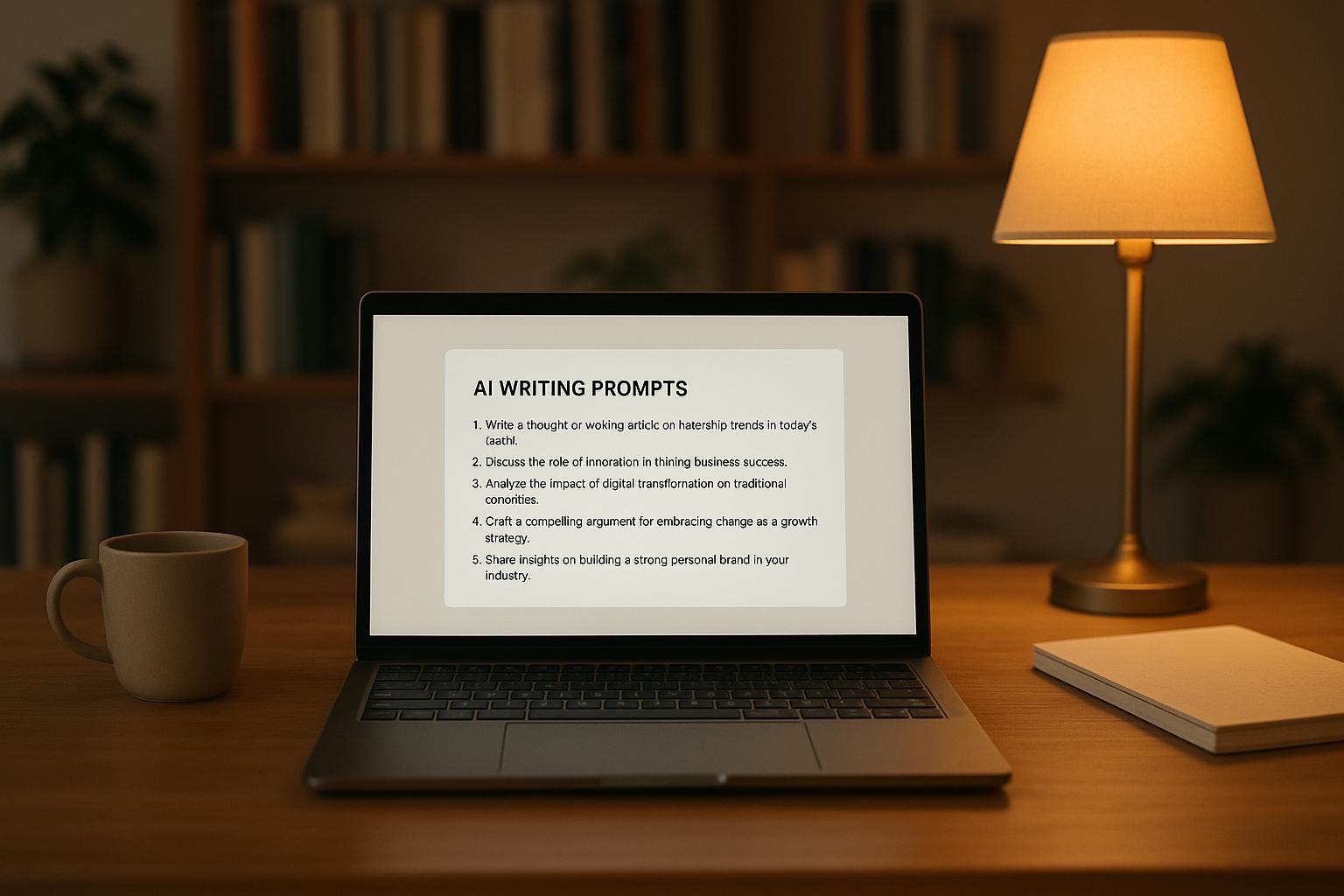
Thought leaders face a growing challenge: standing out in a world where AI-generated content is everywhere. With 39% of executives using AI tools like ChatGPT and Copilot, the risk of repetitive, generic ideas is higher than ever. To stay ahead, leaders must focus on producing content that reflects their expertise and avoids conventional thinking.
Key Takeaways:
- AI tools can amplify your voice, but originality is key.
- Use AI-generated prompts to explore trends, challenge industry norms, and craft engaging success stories.
- Tools like Pressmaster.ai can analyze your style and audience to create tailored prompts that help you stand out.
- Success lies in combining AI efficiency with your personal insights to deliver content that resonates.
The best ChatGPT Prompt I've ever created - I spent 2 months curating this prompt to write prompts
1. Emerging Trends
AI-driven content creation is advancing rapidly, and staying ahead means understanding three important trends shaping the way thought leaders can stand out. These trends highlight how AI can amplify unique voices while ensuring originality remains at the forefront.
Real-Time Industry Intelligence Integration
One of the most exciting developments in AI writing tools is the ability to integrate real-time industry data. This ensures content stays both relevant and authoritative. These tools scan massive amounts of industry news, social media chatter, and academic research to pinpoint emerging topics and trends well before they hit the mainstream [6][5].
For example, Pressmaster.ai's Trendmaster analyzes over 500,000 sources daily, identifying key shifts weeks ahead of the broader media. It cross-references these trends with a thought leader's content history and audience interests, producing prompts that are not only timely but also aligned with their personal brand.
Imagine receiving a prompt like: "What are three under-discussed trends shaping the future of remote work in the US?" This kind of insight positions leaders as forward-thinkers who are always a step ahead [3][5].
And the results speak for themselves. Thought leaders using these trend-focused prompts report higher engagement rates, as audiences increasingly value content that prepares them for what’s coming instead of just reacting to what’s already happened.
Hyper-Personalized Prompt Generation
Another major shift is the rise of AI systems that adapt to the unique style, expertise, and audience preferences of individual thought leaders. These tools go beyond generic suggestions, using past content, speaking topics, and audience feedback to craft prompts that are tailor-made.
For instance, instead of offering a broad global perspective, these systems might generate something highly specific, like: "How will new US data privacy laws impact digital marketing strategies in 2026?" By focusing on region-specific data, idioms, and regulations, the prompts resonate more deeply with target audiences [6][5].
Beyond personalization, these tools use natural language processing to analyze past articles and posts, ensuring fresh ideas without repeating old content. They can even inject unconventional angles, such as: "What is a common misconception about AI adoption in US manufacturing, and why is it wrong?" This keeps the content fresh and thought-provoking.
Take Bernard Marr, a well-known tech expert, as an example. He uses AI tools to tailor prompts to his expertise in big data and AI ethics. This strategy allows him to consistently produce timely, insightful articles that attract large audiences and solidify his role as a leading voice in technology [2].
By leveraging these personalized prompts, thought leaders can consistently deliver content that feels relevant and original.
Contrarian Angle Amplification
The third trend revolves around AI’s ability to push thought leaders toward bold, unconventional perspectives. As AI-generated content becomes more widespread, audiences are increasingly drawn to ideas that break from the norm.
AI tools now excel at identifying common industry assumptions and generating prompts like: "How will generative AI transform customer experience in retail by 2026?" These prompts challenge traditional narratives and encourage leaders to explore new angles [3][5].
This approach helps avoid the "echo chamber" effect, where similar datasets produce repetitive insights. Instead of contrarian views for shock value, these systems uncover genuine gaps or overlooked aspects in current discussions, ensuring the resulting content is both meaningful and distinct.
Leaders who embrace this style often find their most engaging ideas come from prompts that push them to defend or rethink their positions. This not only sets them apart but also demonstrates a level of thought leadership that goes beyond simply reporting trends.
2. Contrarian Perspectives
Influential thought leaders often stand out by challenging the status quo. By leveraging insights into emerging trends, you can sharpen your ability to think differently. AI plays a key role in this process, uncovering overlooked areas in your field and spotlighting questions that others might shy away from. Below are three impactful ways to create content that challenges conventional wisdom.
These contrarian strategies, paired with trend-driven insights, can help you craft content that stands out as genuinely original.
Challenge Sacred Industry Practices
Every industry has its "golden rules" or best practices that people rarely question. But what if those practices aren't as effective as everyone assumes? This is where AI shines - it can identify these long-held norms and help you generate prompts to question them. For instance, an AI tool might suggest something like: "What if the most popular productivity method in your industry is actually making teams less efficient?"
This kind of approach prompts your audience to rethink deeply ingrained beliefs. Thought leaders who dare to challenge these norms often carve out a unique reputation for themselves.
AI tools can analyze the most common advice in your industry and flip it on its head, but the key here is backing up your perspective with solid data. A contrarian view that's supported by evidence will resonate far more than one that's purely speculative.
Expose Hidden Industry Misconceptions
Some of the most engaging content comes from exposing myths or misconceptions. AI can help uncover these by analyzing gaps between what people believe and what the data actually shows. This opens the door to prompts like: "Three things everyone in [your industry] believes that are completely wrong - and the data that proves it."
This approach positions you as someone willing to dig deeper while others stick to surface-level ideas. In an era where 39% of executives are using generative AI tools, there's a growing risk of repetitive, unoriginal insights [3]. To stand out, the best contrarian content doesn’t just highlight what’s wrong - it also offers a better way forward. AI can help you structure these arguments by first addressing the prevailing belief, then presenting data that challenges it, and finally suggesting a more accurate perspective.
Question Overhyped Trends
It’s not just about debunking myths - sometimes, it’s about questioning whether a trend is as impactful as everyone says it is. While many rush to embrace the latest industry buzz, true contrarian thinkers step back and ask: "Is this trend really worth all the hype?" AI tools can identify trends that are getting excessive attention compared to their actual results, giving you prompts like: "Why everyone is wrong about [trending topic] and what you should focus on instead."
Timing and evidence are critical here. The goal isn’t to be contrarian just for the sake of it, but to provide a more thoughtful perspective when enthusiasm outpaces real-world outcomes. AI can analyze how much attention a trend is getting versus its measurable impact, helping you pinpoint when the hype might be overblown.
3. Success Stories
These examples show how AI prompts can turn expert ideas into engaging and original content, showcasing the power of combining technology with creativity.
Turning Numbers into Stories: Geni Whitehouse's Accounting Approach
Geni Whitehouse has reshaped the way accounting professionals communicate by teaching them how to "tell stories with numbers." In 2022, she introduced a fresh approach that helped accounting firms better demonstrate their value to clients, leading to stronger client engagement and improved advisory services [2]. By using AI to uncover unique insights, she shifted the focus from dry financial reports to creating content that clients genuinely want to read and understand. This storytelling method has not only deepened client relationships but also positioned these firms as reliable and trusted business partners.
Highlighting Overlooked Trends: John Dyck's Manufacturing Insights
John Dyck has carved a niche for himself by using AI-driven gap analysis to spotlight underexplored trends in manufacturing digitalization [2]. By addressing these overlooked areas with fresh perspectives, he has managed to create standout content in a highly competitive industry [7]. His insights have earned him speaking slots at major industry events and opportunities to contribute to top publications. This demonstrates how AI-powered prompts can help thought leaders uncover new opportunities and stay ahead in established fields.
Leaders across various industries are using similar strategies to break down complex ideas into engaging and easily digestible content.
Simplifying Cybersecurity: Rachel Tobac's Interview Strategy
Rachel Tobac has built her reputation in the cybersecurity world by using AI to streamline expert interviews and deliver actionable advice on emerging threats [2]. With the help of AI tools, she transcribes and organizes expert insights, transforming technical discussions into accessible, clear content for a wide audience. This process has significantly boosted audience engagement and expanded her reach on social media platforms. As a result, she has established herself as a trusted authority in cybersecurity, with her content frequently shared across professional networks.
These examples highlight how AI-powered prompts not only increase productivity but also help refine and amplify unique narratives. They show the importance of blending authenticity with AI-driven storytelling in today’s content-driven world.
4. Practical Insights
Turning bold ideas and trends into actionable strategies often comes down to how effectively you integrate AI prompts into your routine. Let’s dive into how you can make this part of your daily workflow.
The Daily AI Prompt Integration Strategy
Incorporating AI prompts into your everyday tasks can be a game-changer for maintaining originality and clarity. Many top executives already use AI prompts daily to sharpen their messaging and boost efficiency. This practice has become a go-to recommendation for technology consultants advising leaders on improving workflows [3].
Here’s how to make it work: start with prompts that encourage diverse viewpoints while staying true to your personal style. Instead of staring at a blank page, thought leaders often kick off their creative process with targeted prompts designed to push the boundaries of conventional thinking. For example, try this: "Act as an expert in [your field]. Provide three fresh perspectives on a current industry challenge and suggest actionable solutions for each." This approach not only helps you tap into your expertise but also ensures your content is both relevant and stands out [3][4].
To maximize the impact, customize prompts to suit your audience’s unique needs. Specify details like audience demographics, industry trends, or specific challenges they face. For instance, a prompt like "Create a LinkedIn post for mid-level tech managers, offering innovative strategies to enhance remote team engagement" ensures your message hits the mark with the right audience [3][4].
Once you’ve generated ideas, take the time to refine them. AI outputs aren’t perfect, so it’s crucial to review for accuracy, relevance, and originality. Thought leaders should ensure the content aligns with their expertise and adds unique value before hitting publish. This step is key to maintaining high standards and avoiding the generic or repetitive pitfalls that can dilute your voice [3][6].
Finally, track how your audience responds. Monitor engagement metrics like likes, shares, and comments, and pay attention to direct feedback. This will help you pinpoint which prompts are driving the most impactful content. Over time, this data-driven approach allows you to fine-tune your strategy [3][4].
If you’re looking for tools to simplify this process, platforms like Pressmaster.ai offer tailored solutions for thought leaders. Their AI Strategizer, trained on over 1 million viral articles, generates compelling content angles designed to resonate with your audience. The brand voice feature ensures AI-generated content mirrors your personal communication style, while the Trendmaster tool scans over 500,000 data sources daily. This allows you to identify emerging topics weeks ahead of the curve, giving you a head start in crafting timely, engaging content that keeps you ahead of the conversation.
Conclusion
The world of thought leadership has undergone a major transformation. While AI has made it easier and faster to produce content, it has also introduced a new challenge: delivering original, meaningful ideas that truly connect with audiences. The leaders who stand out are those who consistently bring fresh, impactful insights to the table.
AI-generated writing prompts are proving to be a game-changer. Instead of replacing human creativity, these tools act as a catalyst, helping you uncover new perspectives and explore ideas you might not have considered otherwise. This approach is quickly becoming a must for staying relevant and competitive.
Here’s the takeaway: AI doesn’t dilute authenticity - it strengthens it. By using AI prompts to tackle emerging topics, question conventional thinking, share personal success stories, or simplify complex ideas into actionable insights, you’re not losing your voice. Instead, you’re elevating your expertise and ensuring it resonates with the right audience at the right time.
Think about the practical benefits: instead of wasting hours staring at a blank screen, you can focus on what matters most - bringing your unique experiences and insights to life. AI takes care of brainstorming and structuring, while you provide the human touch that audiences crave: real-world perspective, personal experience, and genuine expertise.
The most effective thought leaders don’t see this as a choice between human creativity and AI. Instead, they embrace a collaborative process where AI helps them think more deeply, explore more possibilities, and communicate more clearly. Whether you’re challenging industry norms with bold ideas or inspiring action through relatable success stories, AI prompts provide the framework to consistently deliver value.
Your ideas deserve to make an impact, and AI can help amplify them. Tools like Pressmaster.ai turn this vision into reality by offering detailed analytics to track what resonates most with your audience. Users have reported incredible results, including a 10,643% increase in post impressions and a 24% boost in followers in just a week [1].
The choice for today’s thought leaders is clear: adapt to this new era where original thinking sets you apart, or risk fading into the background of an increasingly crowded space. AI writing prompts are more than just efficiency tools - they’re your edge in the competition for attention and influence.
The future belongs to those who can seamlessly blend AI’s power with their authentic voice. Start experimenting with AI prompts now, monitor your outcomes, and fine-tune your strategy based on what engages your audience. Let AI be your creative partner, ensuring your unique perspective remains your strongest advantage.
FAQs
How do AI-generated writing prompts help thought leaders create unique and impactful content?
AI-generated writing prompts provide thought leaders with new and customized ideas that match their expertise, audience interests, and current industry trends. These prompts are a great way to tackle writer’s block while keeping content engaging and on point.
With the help of AI, thought leaders can save time without sacrificing originality, giving them more room to focus on creating messages that genuinely connect with their audience.
How can I use AI-generated prompts daily to create better content as a thought leader?
Integrating AI-generated prompts into your daily routine can be a game-changer for consistently producing engaging and fresh content. Dedicate a specific time each day to generate and review prompts that align with your expertise and resonate with your audience. This habit helps ensure a constant stream of new ideas.
AI prompts can serve as a starting point for brainstorming or structuring your content. Whether you're drafting blog posts, crafting social media updates, or scripting videos, these prompts provide a helpful foundation. To maximize efficiency, focus on prompts that reflect current industry trends or address your audience's most pressing questions.
The magic happens when you blend AI-generated ideas with your personal insights and experiences. This mix not only enhances the originality of your content but also ensures it connects with readers on a deeper, more relatable level.
How can AI tools help thought leaders challenge industry norms and deliver fresh insights?
AI tools excel at sifting through massive amounts of industry data to pinpoint new trends and reveal areas where traditional approaches might fall short. With this insight, thought leaders can develop fresh viewpoints and create content that grabs attention.
On top of that, AI-generated prompts are designed to align with your expertise and target audience. This ensures your messaging stays sharp and resonates with readers. These tools also encourage you to challenge conventional ideas and share concepts that connect on a deeper level, sparking stronger engagement and originality.








Sign Up for our Pressmaster Newsletter
Sign up for our Pressmaster.ai newsletter to get instant alerts on trending topics, ensuring you stay ahead in your field with the latest insights and updates.


.avif)
.png)

.avif)


7 Viral Patterns That Drove 10,643% Growth
Turn natural conversations into content gold, make every insight count, and drive real conversations.

Please fill out the form to get our Viral Cheat Sheet


How to Become a Thought Leader in 6 Easy Steps
Increase your visibility, establish authority, and conquer your market with minimal effort.

Please fill out the form to get our PDF Checklist
